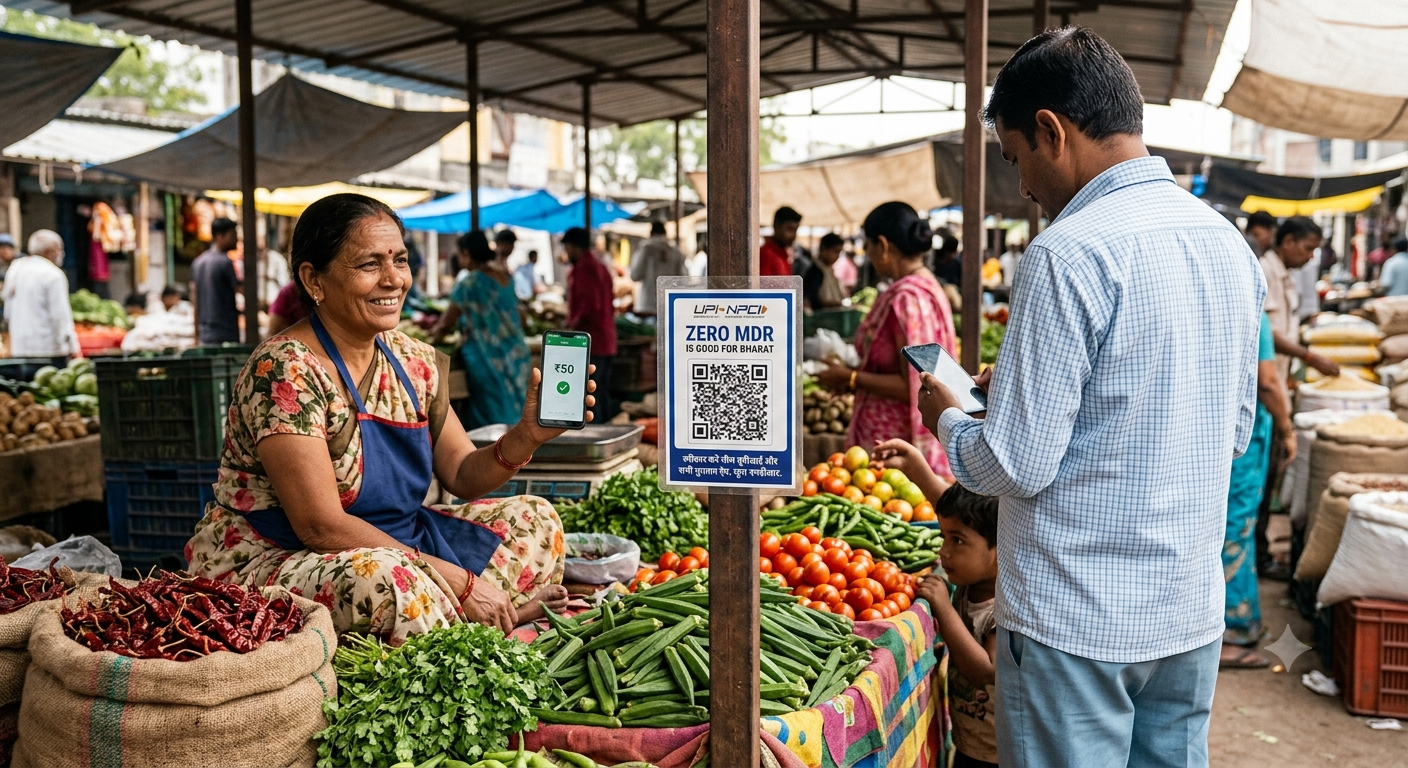

Every few months, a familiar debate resurfaces in fintech circles: *"When will UPI stop being free?"*
Traditional bankers point to server maintenance costs, payment apps highlight engineering overheads, and financial analysts insist that "free payments cannot exist in a free-market economy." On paper, their argument sounds logical: when a merchant accepts a credit or debit card, they pay a 1.5% to 2% **Merchant Discount Rate (MDR)**. Why should UPI be any different?
Yet, the decision by the Indian government and the **National Payments Corporation of India (NPCI)** to enforce **Zero MDR** on consumer-to-merchant UPI transactions remains one of the single greatest economic masterstrokes in modern history.
Far from being an artificial subsidy, **Zero MDR is the core engine of India's Digital Public Infrastructure (DPI)**. Here is why reintroducing MDR on everyday UPI transactions is not just unrequired—it would actively undermine the economy.
- Zero MDR Eliminates the "Cash Preference" Friction: For small-and-medium enterprise (SME) merchants, profit margins are razor-thin—often hovering around 3% to 8%.
1.1 If a *kirana* store owner or street vendor is charged a 1% to 2% MDR on digital transactions, **digital payments instantly transform from a convenience into a direct penalty on their bottom line.**1.2 What happens when merchants are charged MDR? * They ask customers for cash instead.1.3 * They set "minimum transaction amounts" for digital payments.1.4 * They pass the fee directly onto the buyer.
By enforcing Zero MDR, NPCI made digital payments **cost-neutral against physical cash**. A merchant accepts ₹50 via a QR code and receives exactly ₹50 in their bank account. This zero-friction onboarding is why India expanded from a few million payment terminals to over 300 million QR code touchpoints in less than a decade.
2. The Economic Savings of Replacing Physical Cash Exceed the Cost of Digital Rails. Opponents of Zero MDR argue that processing billions of transactions monthly costs banks and tech companies real money. That is true. However, looking *only* at switching costs ignores the massive hidden expense of physical cash:
2. The Economic Savings of Replacing Physical Cash Exceed the Cost of Digital Rails. Opponents of Zero MDR argue that processing billions of transactions monthly costs banks and tech companies real money. That is true. However, looking *only* at switching costs ignores the massive hidden expense of physical cash:
2.1 **Printing & Transportation:** The Reserve Bank of India (RBI) and commercial banks spend tens of thousands of crores annually printing currency notes, transporting armored vehicles, and stocking physical ATMs.2.2 **Leakage & Tax Evasion:** Cash transactions fuel shadow economies and informal credit markets that bypass tax collection.2.3 **Operational Overhead:** Counting, sorting, and depositing cash at bank branches drains hours of merchant productivity every week.
When viewed from a macro-economic perspective, funding UPI's zero-MDR infrastructure through government support and ecosystem incentive schemes costs a fraction of managing physical cash currency. Zero MDR isn't "free"—it is a far cheaper alternative to paper money.
3. Financial Data is the New Revenue Engine (Not Transaction Fees) : In traditional credit card systems (like Visa or Mastercard), payment platforms rely strictly on transaction fees. UPI flipped this model on its head. In a Zero-MDR ecosystem, the real value generated by a payment app or bank isn't a 20-paise fee on a cup of tea; **it is the transaction metadata.**
3.1 Formal Credit History: Prior to UPI, a tea vendor had zero paper trail and was forced to borrow money from local loan sharks at 30–40% interest. Today, 12 months of UPI transaction logs allow banks to assess the vendor's cash flow instantly and offer formal micro-loans, working capital lines, and insurance.3.2 Cross-Selling Opportunities: Fintech apps monetize their vast, active user bases by offering mutual funds, term insurance, credit cards, and merchant SaaS tools.
Zero MDR acts as the ultimate low-cost acquisition funnel. The payment itself is a loss-leader or break-even feature that unlocks a lifetime of high-margin financial services.
4. NPCI’s Financial Performance Proves the Ecosystem Works Without Squeezing Small Merchants : A common myth is that operating without MDR makes the central payment umbrella financially unviable. NPCI’s annual financial performance tells a completely different story: NPCI generated **₹4,240 crore in operating revenue in FY26** (up 22% from ₹3,481 crore in FY25). Even after distributing over ₹1,400 crore in bank incentives, marketing programs, and RuPay promotions, NPCI recorded a net surplus of **₹991 crore in FY26**. NPCI doesn't need to charge small merchants for UPI transfers. It funds its infrastructure via switching charges on volume channels, switching fees on card networks, FASTag toll routing, corporate NACH clearing, and treasury income from its balance sheet reserves. This financial health proves that payment infrastructure can thrive through scale, volume efficiency, and multi-channel services without taxing small-business transactions.
5. Network Effects: Why "Almost Free" Doesn't Work Could India implement a tiny 0.1% MDR instead of zero?
In economic theory, small fees sound harmless. In behavioral psychology, however, **there is an infinite gulf between "Free" and "0.1%". The moment a fee—no matter how small—is introduced, it creates cognitive resistance:
In economic theory, small fees sound harmless. In behavioral psychology, however, **there is an infinite gulf between "Free" and "0.1%". The moment a fee—no matter how small—is introduced, it creates cognitive resistance:
* Merchants begin evaluating whether to keep their QR code stickers or tear them down.* P2M (Person-to-Merchant) transaction velocity slows down.* Cash makes a aggressive comeback at the bottom of the pyramid.
Maintaining Zero MDR ensures that UPI remains an **indispensable utility**—much like national highways, street lighting, or public water lines. You do not charge a toll on every footstep taken on a public sidewalk, because the broader economic activity generated by those sidewalks pays for their construction tenfold.
Conclusion: Zero MDR is Public Infrastructure, Not a Commercial Monopoly
The argument for MDR stems from an outdated mindset that views payments as a private commercial product.
India proved to the world that payment rails are **Digital Public Infrastructure (DPI)**. By keeping basic UPI transfers completely free of MDR for small merchants, India achieved in eight years what took developed nations three decades: total financial inclusion, a massive reduction in the cash economy, and the world's most vibrant fintech ecosystem.
As long as policymakers treat UPI as the foundational digital highway for economic growth rather than a toll booth, India’s financial ecosystem will continue to lead the world.
The argument for MDR stems from an outdated mindset that views payments as a private commercial product.
India proved to the world that payment rails are **Digital Public Infrastructure (DPI)**. By keeping basic UPI transfers completely free of MDR for small merchants, India achieved in eight years what took developed nations three decades: total financial inclusion, a massive reduction in the cash economy, and the world's most vibrant fintech ecosystem.
As long as policymakers treat UPI as the foundational digital highway for economic growth rather than a toll booth, India’s financial ecosystem will continue to lead the world.


























0 Thoughts on this article