
NPCI Unveils New UPI Merchant Discount Rate (MDR) Framework
The National Payments Corporation of India (NPCI) has officially announced a new Merchant Discount Rate (MDR) framework for Unified Payments Interface (UPI) transactions, ending India's six-year zero-MDR regime. Effective October 15, 2026, the policy introduces a structured fee layout targeted at high-value transactions to ensure the digital payments ecosystem becomes self-sustainable. [1" target="_blank" rel="noopener noreferrer">https://www.youtube.com">1, 2" target="_blank" rel="noopener noreferrer">https://indianexpress.com">2, 3" target="_blank" rel="noopener noreferrer">https://theaspirantnews.com">3]
Here is a comprehensive news analysis of the new UPI MDR rules, who they impact, the political economy behind the move, and the projected financial outcomes.
📊 The Core Policy: What is Changing?
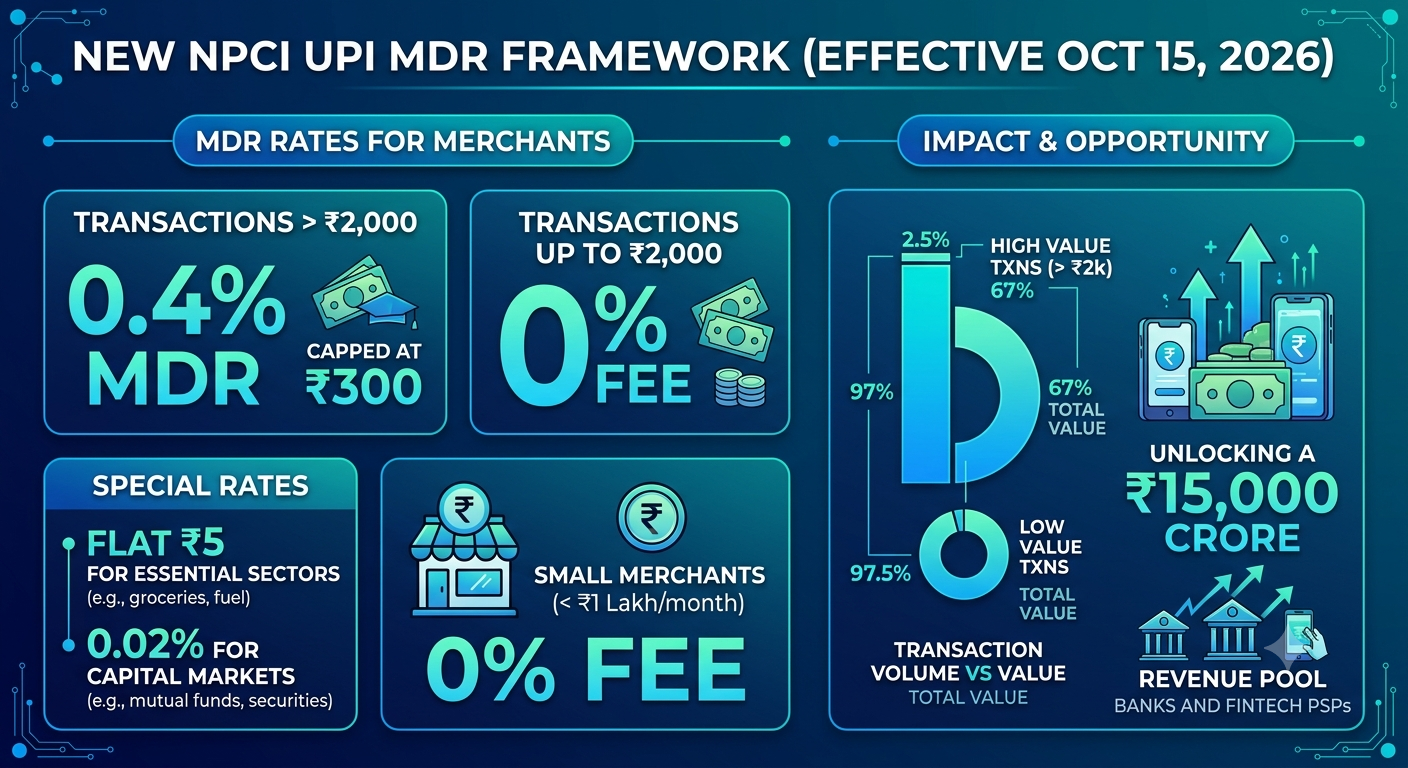
Starting October 15, select high-value Person-to-Merchant (P2M) UPI transactions above ₹2,000 will attract a standard 0.4% MDR levy paid by mid-sized and large merchants. [2" target="_blank" rel="noopener noreferrer">https://indianexpress.com">2, 4" target="_blank" rel="noopener noreferrer">https://www.youtube.com">4, 5" target="_blank" rel="noopener noreferrer">https://vajiramandravi.com">5]
- Standard P2M Transactions (> ₹2,000): 0.4% MDR fee, capped at ₹300 for transactions ≥ ₹75,000.
- Essential / Low-Margin Sectors: Flat ₹5 per transaction for Railways, Fuel, Telecom, Insurance, and Agri-inputs (only applies to transactions above ₹2,000).
- Capital Markets: 0.02% fee capped at ₹300 per transaction for Mutual funds, stockbrokers, and equities.
- Small Merchants: 0% (Exempt) for P2PM category earning < ₹1 Lakh/month to protect small local vendors.
- Transactions up to ₹2,000: 0% (Free), covering the vast majority of daily retail volume.
- Person-to-Person (P2P) Transfers: 0% (Free) regardless of the transaction amount.
🔎 Impact Analysis
1. Impact on Consumers: Directly Free, Indirectly Vulnerable
For everyday users, UPI remains free. The NPCI and the Ministry of Finance have stated that UPI apps are prohibited from adding platform or hidden checkout fees. However, analysts note that while consumers will not see an extra charge at the billing counter, large merchants may indirectly pass these new operational costs down via increased product pricing. The Finance Ministry has already initiated discussions with payment aggregators to set up monitoring mechanisms to penalise merchants who try to explicitly pass this 0.4% fee to buyers. [6" target="_blank" rel="noopener noreferrer">https://www.youtube.com">6, 7" target="_blank" rel="noopener noreferrer">https://www.youtube.com">7, 8" target="_blank" rel="noopener noreferrer">https://www.youtube.com">8, 9" target="_blank" rel="noopener noreferrer">https://thefederal.com">9]
2. The Microeconomic Logic: Volumetric vs. Value Targets
Though this policy seems sweeping, it targets only a sliver of total transaction volume. Approximately 2.5% of all UPI transactions by volume exceed the ₹2,000 threshold. Crucially, however, this 2.5% volume accounts for roughly 67% of the total financial value moving through the network. By carving out transactions below ₹2,000 and exempting small traders earning under ₹1 lakh a month, the government has isolated high-ticket transactions to generate revenue without disrupting lower-income users. [4" target="_blank" rel="noopener noreferrer">https://www.youtube.com">4, 7" target="_blank" rel="noopener noreferrer">https://www.youtube.com">7, 10" target="_blank" rel="noopener noreferrer">https://www.thehindu.com">10]
3. Financial Sector Winners: A ₹15,000 Crore Revenue Pool
The implementation of MDR is estimated to unlock an immediate industrial revenue line of ₹15,000 crore to ₹18,000 crore annually. This processing fee will be shared inside the infrastructure layer: [2" target="_blank" rel="noopener noreferrer">https://indianexpress.com">2, 7" target="_blank" rel="noopener noreferrer">https://www.youtube.com">7, 11" target="_blank" rel="noopener noreferrer">https://www.youtube.com">11]
- The Payer’s Bank: Takes the largest cut of the fee for handling the core savings account infrastructure.
- Merchant Acquiring Banks & Payment Service Providers (PSPs): Entities such as Paytm, PhonePe, and Pine Labs will split the remainder (estimated by brokerages like Emkay Global at around 12 basis points of the total 40 basis points charge). [2" target="_blank" rel="noopener noreferrer">https://indianexpress.com">2, 11" target="_blank" rel="noopener noreferrer">https://www.youtube.com">11]
This move sparked a rally in fintech and banking equities, as these firms have previously been absorbing massive compliance, server, and cybersecurity costs under a heavily government-subsidised model. [1" target="_blank" rel="noopener noreferrer">https://www.youtube.com">1, 3" target="_blank" rel="noopener noreferrer">https://theaspirantnews.com">3, 12" target="_blank" rel="noopener noreferrer">https://m.economictimes.com">12]
💡 Geopolitical & Domestic Political Criticism
The policy update has invited intense public debate across multiple sectors:
- Allegations of US Lobbying: The political opposition argued that the government gave in to external pressures from the U.S. Trade Representative (USTR). Historically, American credit card giants like Visa and Mastercard have complained that the zero-MDR framework on domestic RuPay and UPI systems created an uneven playing field, blocking foreign networks from competing fairly. [1" target="_blank" rel="noopener noreferrer">https://www.youtube.com">1, 3" target="_blank" rel="noopener noreferrer">https://theaspirantnews.com">3, 13" target="_blank" rel="noopener noreferrer">https://www.thehindu.com">13]
- The Government's Defense: The Department of Financial Services (DFS) strongly refuted these claims on X, declaring that the charge was designed entirely independently to foster domestic fintech competition and build a self-sustaining system. DFS asserted that the move ensures long-term "sovereignty in the electronic payment ecosystem" by making it viable for domestic companies to scale without relying forever on government subsidies. [1" target="_blank" rel="noopener noreferrer">https://www.youtube.com">1, 3" target="_blank" rel="noopener noreferrer">https://theaspirantnews.com">3, 13" target="_blank" rel="noopener noreferrer">https://www.thehindu.com">13]
- Complexity Concerns: Financial editorials (such as The" target="_blank" rel="noopener noreferrer">https://www.thehindu.com">The Hindu) have criticised the structure as "overly complex," pointing out that adding separate flat fees, percentage tiers, caps, and sector-based gradations reflects a fear of political fallout rather than sound, streamlined economic design. [10" target="_blank" rel="noopener noreferrer">https://www.thehindu.com">10]
If you want to dig deeper into the market implications, I can provide an analysis of which fintech and banking stocks stand to gain the most from the revenue split, or more details on how the government plans to penalise merchants who try to pass the fee onto consumers.



























0 Thoughts on this article