Current-Affairs • Burning Issues • Geopolitics
U.S.-Iran conflict
#US #Iran #conflict #Nuclear #ballistic #2026
Understanding the Deep-Rooted U.S.-Iran Conflict
The...
Understanding the Deep-Rooted U.S.-Iran Conflict
The U.S.-Iran conflict stems from decades of deep historical, political, and strategic hostility that erupted into open warfare in early 2026. Understanding the roots and modern drivers of this geopolitical standoff is crucial for analyzing stability in the Middle East.
Direct Answer Overview
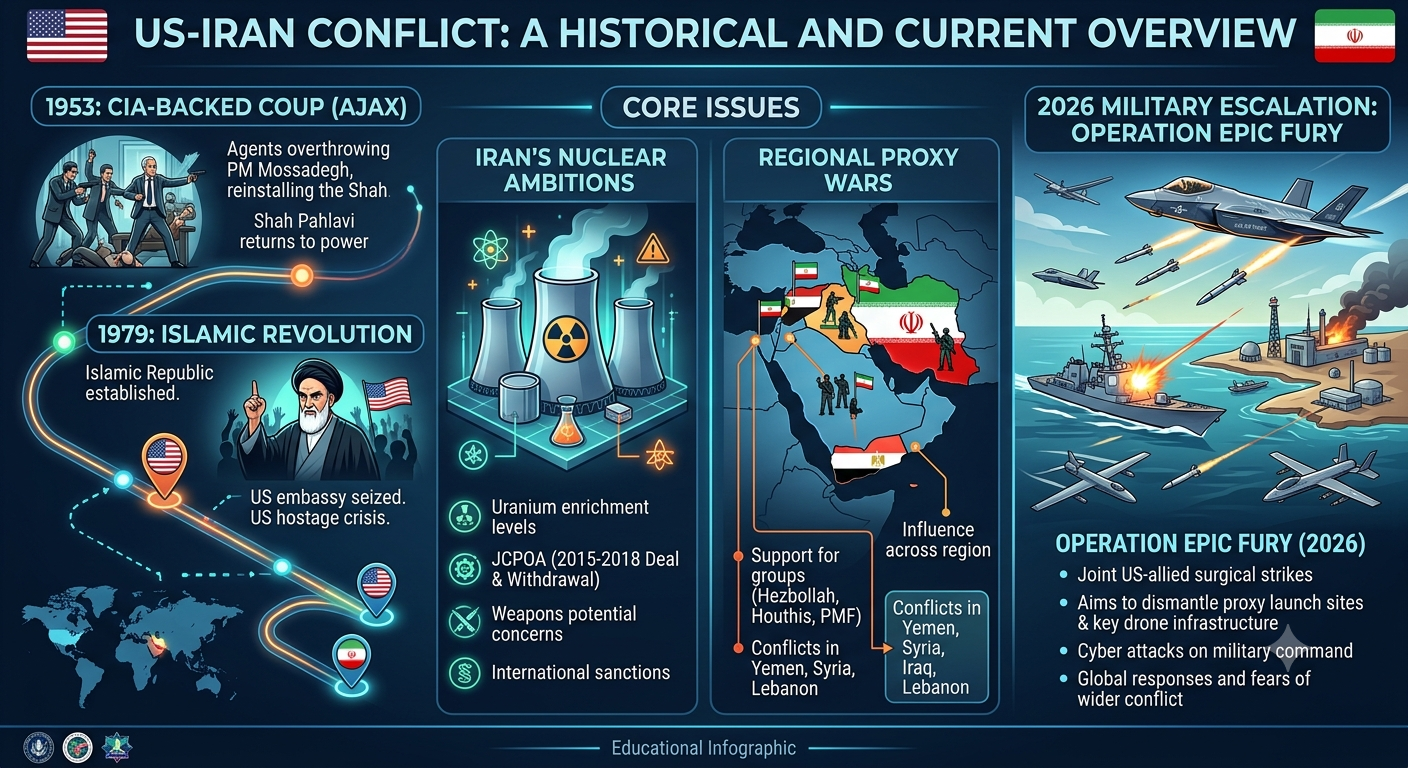
The core of the conflict centers on Iran's nuclear and ballistic missile programs, its support for regional proxy groups, control of the strategic Strait of Hormuz, and the long legacy of U.S. intervention in Iranian governance dating back to 1953.
Historical Roots of Tension
To grasp the current crisis, one must examine key historical turning points that fractured bilateral relations:
- 1953 Coup (Operation Ajax): The U.S. Central Intelligence Agency (CIA) and British intelligence orchestrated the overthrow of Iran's democratically elected Prime Minister, Mohammad Mossadegh, restoring the pro-Western Shah. Many Iranians view this as the original sin that destroyed Iranian democracy.
- 1979 Islamic Revolution: The brutal rule of the U.S.-backed Shah led to a popular revolution, overthrowing the monarchy and establishing an anti-Western theocracy under Ayatollah Khomeini.
- The Hostage Crisis: Iranian students seized the U.S. Embassy in Tehran in 1979, holding 52 Americans hostage for 444 days. This severed formal diplomatic ties, which remain non-existent today (with Pakistan and Switzerland acting as protecting powers).
Core Issues and Drivers
Several strategic friction points continue to fuel direct confrontation between both nations:
- Nuclear Ambitions: The U.S. and Israel view a nuclear-armed Iran as an existential and regional threat. Iran insists its program is peaceful, though it has enriched uranium past civilian limits following the collapse of the 2015 Joint Comprehensive Plan of Action (JCPOA).
- Regional Influence: Washington opposes Iran's backing of regional militias and proxy networks—such as Hezbollah, the Houthis, and groups in Iraq—which target U.S. allies (Israel and Gulf Arab states) and American bases.
- Economic Sanctions & "Maximum Pressure": Successive U.S. administrations—particularly under President Donald Trump—have imposed punishing economic sanctions to crush Iran's oil exports and force strategic capitulation, triggering severe economic crises inside Iran.
- Strait of Hormuz: As a critical global oil chokepoint, Iran's frequent assertions of control and disruptions to commercial shipping in the strait remain flashpoints for direct military confrontation.
Recent Military Escalation (2026)
In 2026, long-simmering tensions escalated into major kinetic operations:
- Operation Epic Fury: On February 28, 2026, the United States and Israel launched massive joint military strikes against Iranian military, nuclear, and leadership infrastructure, resulting in the death of Supreme Leader Ali Khamenei.
- Retaliation and Strain: Iran responded with extensive missile and drone barrages targeting regional U.S. assets and commercial shipping. The active conflict has strained U.S. military logistics and munitions stockpiles.
- Fragile Ceasefires: Despite Pakistan- and Qatar-mediated interim ceasefires and memoranda of understanding to halt large-scale fighting and reopen shipping lanes, intermittent strikes and compliance disputes mean a durable, comprehensive diplomatic settlement remains elusive.
Key References & External Sources
For further reading and historical documentation, explore the following resources:
Current-Affairs • National • Policy Changes
The National Payments Corporation of India (NPCI) has officially announced a new Merchant Discount Rate (MDR) framework for Unified Payments Interface (UPI) transactions
#Npci #upi #mdr #india #ashneer #trending
NPCI Unveils New UPI Merchant...
NPCI Unveils New UPI Merchant Discount Rate (MDR) Framework
The National Payments Corporation of India (NPCI) has officially announced a new Merchant Discount Rate (MDR) framework for Unified Payments Interface (UPI) transactions, ending India's six-year zero-MDR regime. Effective October 15, 2026, the policy introduces a structured fee layout targeted at high-value transactions to ensure the digital payments ecosystem becomes self-sustainable. [1" target="_blank" rel="noopener noreferrer">https://www.youtube.com">1, 2" target="_blank" rel="noopener noreferrer">https://indianexpress.com">2, 3" target="_blank" rel="noopener noreferrer">https://theaspirantnews.com">3]
Here is a comprehensive news analysis of the new UPI MDR rules, who they impact, the political economy behind the move, and the projected financial outcomes.
📊 The Core Policy: What is Changing?
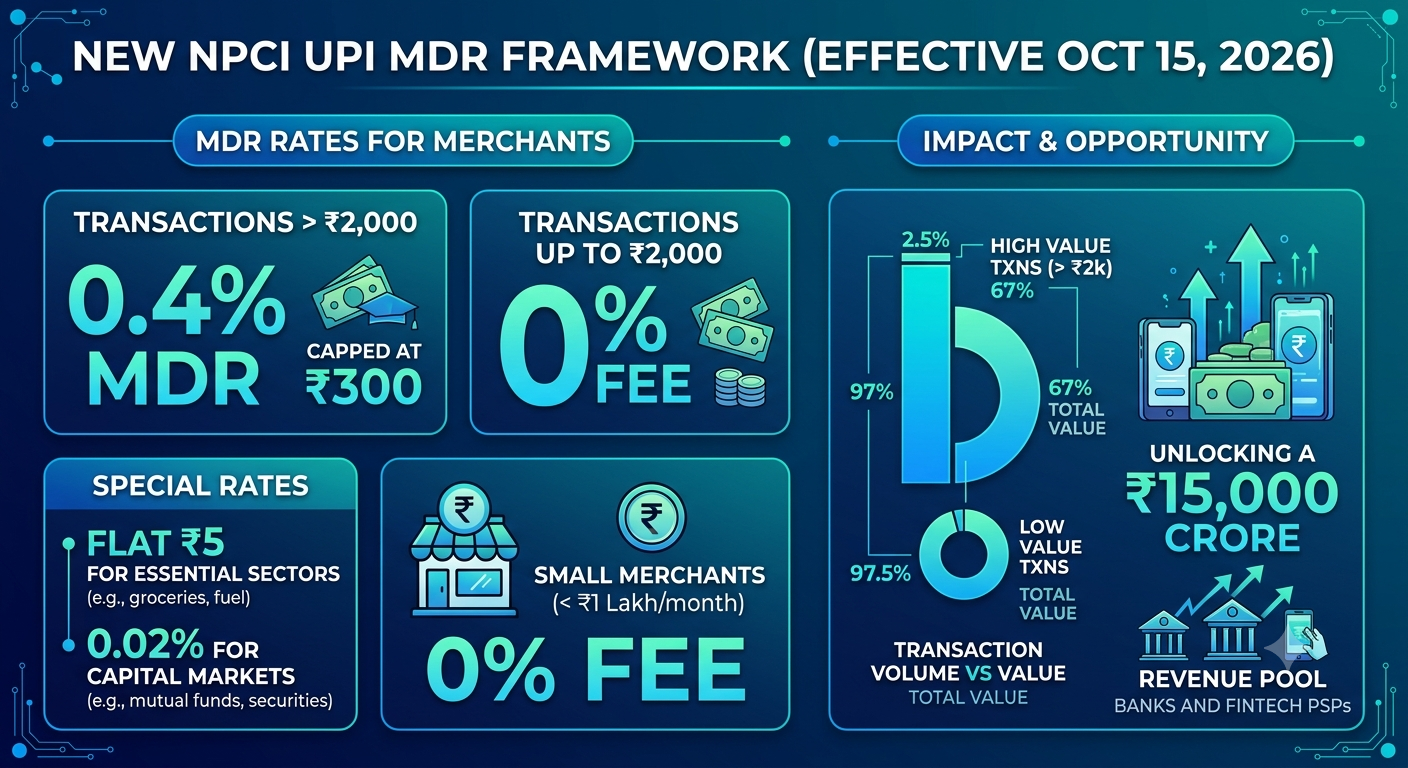
Starting October 15, select high-value Person-to-Merchant (P2M) UPI transactions above ₹2,000 will attract a standard 0.4% MDR levy paid by mid-sized and large merchants. [2" target="_blank" rel="noopener noreferrer">https://indianexpress.com">2, 4" target="_blank" rel="noopener noreferrer">https://www.youtube.com">4, 5" target="_blank" rel="noopener noreferrer">https://vajiramandravi.com">5]
- Standard P2M Transactions (> ₹2,000): 0.4% MDR fee, capped at ₹300 for transactions ≥ ₹75,000.
- Essential / Low-Margin Sectors: Flat ₹5 per transaction for Railways, Fuel, Telecom, Insurance, and Agri-inputs (only applies to transactions above ₹2,000).
- Capital Markets: 0.02% fee capped at ₹300 per transaction for Mutual funds, stockbrokers, and equities.
- Small Merchants: 0% (Exempt) for P2PM category earning < ₹1 Lakh/month to protect small local vendors.
- Transactions up to ₹2,000: 0% (Free), covering the vast majority of daily retail volume.
- Person-to-Person (P2P) Transfers: 0% (Free) regardless of the transaction amount.
🔎 Impact Analysis
1. Impact on Consumers: Directly Free, Indirectly Vulnerable
For everyday users, UPI remains free. The NPCI and the Ministry of Finance have stated that UPI apps are prohibited from adding platform or hidden checkout fees. However, analysts note that while consumers will not see an extra charge at the billing counter, large merchants may indirectly pass these new operational costs down via increased product pricing. The Finance Ministry has already initiated discussions with payment aggregators to set up monitoring mechanisms to penalise merchants who try to explicitly pass this 0.4% fee to buyers. [6" target="_blank" rel="noopener noreferrer">https://www.youtube.com">6, 7" target="_blank" rel="noopener noreferrer">https://www.youtube.com">7, 8" target="_blank" rel="noopener noreferrer">https://www.youtube.com">8, 9" target="_blank" rel="noopener noreferrer">https://thefederal.com">9]
2. The Microeconomic Logic: Volumetric vs. Value Targets
Though this policy seems sweeping, it targets only a sliver of total transaction volume. Approximately 2.5% of all UPI transactions by volume exceed the ₹2,000 threshold. Crucially, however, this 2.5% volume accounts for roughly 67% of the total financial value moving through the network. By carving out transactions below ₹2,000 and exempting small traders earning under ₹1 lakh a month, the government has isolated high-ticket transactions to generate revenue without disrupting lower-income users. [4" target="_blank" rel="noopener noreferrer">https://www.youtube.com">4, 7" target="_blank" rel="noopener noreferrer">https://www.youtube.com">7, 10" target="_blank" rel="noopener noreferrer">https://www.thehindu.com">10]
3. Financial Sector Winners: A ₹15,000 Crore Revenue Pool
The implementation of MDR is estimated to unlock an immediate industrial revenue line of ₹15,000 crore to ₹18,000 crore annually. This processing fee will be shared inside the infrastructure layer: [2" target="_blank" rel="noopener noreferrer">https://indianexpress.com">2, 7" target="_blank" rel="noopener noreferrer">https://www.youtube.com">7, 11" target="_blank" rel="noopener noreferrer">https://www.youtube.com">11]
This move sparked a rally in fintech and banking equities, as these firms have previously been absorbing massive compliance, server, and cybersecurity costs under a heavily government-subsidised model. [1" target="_blank" rel="noopener noreferrer">https://www.youtube.com">1, 3" target="_blank" rel="noopener noreferrer">https://theaspirantnews.com">3, 12" target="_blank" rel="noopener noreferrer">https://m.economictimes.com">12]
💡 Geopolitical & Domestic Political Criticism
The policy update has invited intense public debate across multiple sectors:
- Allegations of US Lobbying: The political opposition argued that the government gave in to external pressures from the U.S. Trade Representative (USTR). Historically, American credit card giants like Visa and Mastercard have complained that the zero-MDR framework on domestic RuPay and UPI systems created an uneven playing field, blocking foreign networks from competing fairly. [1" target="_blank" rel="noopener noreferrer">https://www.youtube.com">1, 3" target="_blank" rel="noopener noreferrer">https://theaspirantnews.com">3, 13" target="_blank" rel="noopener noreferrer">https://www.thehindu.com">13]
- The Government's Defense: The Department of Financial Services (DFS) strongly refuted these claims on X, declaring that the charge was designed entirely independently to foster domestic fintech competition and build a self-sustaining system. DFS asserted that the move ensures long-term "sovereignty in the electronic payment ecosystem" by making it viable for domestic companies to scale without relying forever on government subsidies. [1" target="_blank" rel="noopener noreferrer">https://www.youtube.com">1, 3" target="_blank" rel="noopener noreferrer">https://theaspirantnews.com">3, 13" target="_blank" rel="noopener noreferrer">https://www.thehindu.com">13]
- Complexity Concerns: Financial editorials (such as The" target="_blank" rel="noopener noreferrer">https://www.thehindu.com">The Hindu) have criticised the structure as "overly complex," pointing out that adding separate flat fees, percentage tiers, caps, and sector-based gradations reflects a fear of political fallout rather than sound, streamlined economic design. [10" target="_blank" rel="noopener noreferrer">https://www.thehindu.com">10]
If you want to dig deeper into the market implications, I can provide an analysis of which fintech and banking stocks stand to gain the most from the revenue split, or more details on how the government plans to penalise merchants who try to pass the fee onto consumers.
Current-Affairs • National • Policy Changes
The Zero MDR Paradox: Why Charging Merchants for UPI Would Sabotage India’s Digital Revolution
#npci #upi #mdr
The Zero MDR Paradox:...
The Zero MDR Paradox: Why Charging Merchants for UPI Would Sabotage India’s Digital RevolutionEvery few months, a familiar debate resurfaces in fintech circles: *"
When will UPI stop being free?"*
Traditional bankers point to server maintenance costs, payment apps highlight engineering overheads, and financial analysts insist that "free payments cannot exist in a free-market economy." On paper, their argument sounds logical: when a merchant accepts a credit or debit card, they pay a 1.5% to 2% **
Merchant Discount Rate (MDR)**. Why should UPI be any different?
Yet, the decision by the Indian government and the **
National Payments Corporation of India (NPCI)** to enforce **
Zero MDR** on consumer-to-merchant UPI transactions remains one of the single greatest economic masterstrokes in modern history.
Far from being an artificial subsidy, **
Zero MDR is the core engine of India's Digital Public Infrastructure (DPI)**. Here is why reintroducing MDR on everyday UPI transactions is not just unrequired—it would actively undermine the economy.
- Zero MDR Eliminates the "Cash Preference" Friction: For small-and-medium enterprise (SME) merchants, profit margins are razor-thin—often hovering around 3% to 8%.
1.1 If a *kirana* store owner or street vendor is charged a 1% to 2% MDR on digital transactions, **digital payments instantly transform from a convenience into a direct penalty on their bottom line.**
1.2 What happens when merchants are charged MDR? * They ask customers for cash instead.
1.3 * They set "minimum transaction amounts" for digital payments.
1.4 * They pass the fee directly onto the buyer.
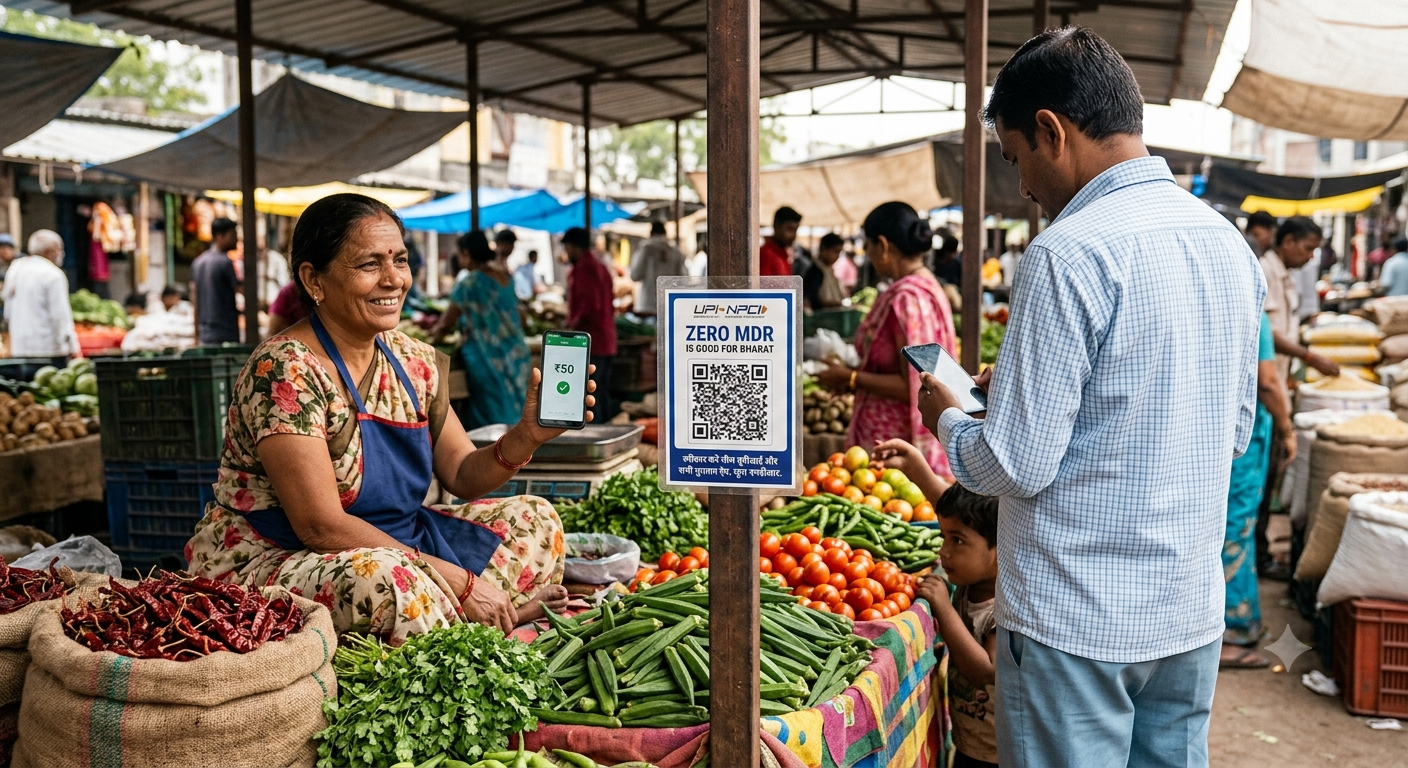
By enforcing Zero MDR, NPCI made digital payments **cost-neutral against physical cash**. A merchant accepts ₹50 via a QR code and receives exactly ₹50 in their bank account. This zero-friction onboarding is why India expanded from a few million payment terminals to over 300 million QR code touchpoints in less than a decade.
2. The Economic Savings of Replacing Physical Cash Exceed the Cost of Digital Rails. Opponents of Zero MDR argue that processing billions of transactions monthly costs banks and tech companies real money. That is true. However, looking *only* at switching costs ignores the massive hidden expense of physical cash:
2.1 **Printing & Transportation:** The Reserve Bank of India (RBI) and commercial banks spend tens of thousands of crores annually printing currency notes, transporting armored vehicles, and stocking physical ATMs.
2.2 **Leakage & Tax Evasion:** Cash transactions fuel shadow economies and informal credit markets that bypass tax collection.
2.3 **Operational Overhead:** Counting, sorting, and depositing cash at bank branches drains hours of merchant productivity every week.
When viewed from a macro-economic perspective, funding UPI's zero-MDR infrastructure through government support and ecosystem incentive schemes costs a fraction of managing physical cash currency. Zero MDR isn't "free"—it is a far cheaper alternative to paper money.
3. Financial Data is the New Revenue Engine (Not Transaction Fees) : In traditional credit card systems (like Visa or Mastercard), payment platforms rely strictly on transaction fees. UPI flipped this model on its head. In a Zero-MDR ecosystem, the real value generated by a payment app or bank isn't a 20-paise fee on a cup of tea; **it is the transaction metadata.**
3.1 Formal Credit History: Prior to UPI, a tea vendor had zero paper trail and was forced to borrow money from local loan sharks at 30–40% interest. Today, 12 months of UPI transaction logs allow banks to assess the vendor's cash flow instantly and offer formal micro-loans, working capital lines, and insurance.
3.2 Cross-Selling Opportunities: Fintech apps monetize their vast, active user bases by offering mutual funds, term insurance, credit cards, and merchant SaaS tools.
Zero MDR acts as the ultimate low-cost acquisition funnel. The payment itself is a loss-leader or break-even feature that unlocks a lifetime of high-margin financial services.
4. NPCI’s Financial Performance Proves the Ecosystem Works Without Squeezing Small Merchants : A common myth is that operating without MDR makes the central payment umbrella financially unviable. NPCI’s annual financial performance tells a completely different story: NPCI generated **₹4,240 crore in operating revenue in FY26** (up 22% from ₹3,481 crore in FY25). Even after distributing over ₹1,400 crore in bank incentives, marketing programs, and RuPay promotions, NPCI recorded a net surplus of **₹991 crore in FY26**. NPCI doesn't need to charge small merchants for UPI transfers. It funds its infrastructure via switching charges on volume channels, switching fees on card networks, FASTag toll routing, corporate NACH clearing, and treasury income from its balance sheet reserves. This financial health proves that payment infrastructure can thrive through scale, volume efficiency, and multi-channel services without taxing small-business transactions.
5. Network Effects: Why "Almost Free" Doesn't Work Could India implement a tiny 0.1% MDR instead of zero?
In economic theory, small fees sound harmless. In behavioral psychology, however, **there is an infinite gulf between "Free" and "0.1%". The moment a fee—no matter how small—is introduced, it creates cognitive resistance:
* Merchants begin evaluating whether to keep their QR code stickers or tear them down.
* P2M (Person-to-Merchant) transaction velocity slows down.
* Cash makes a aggressive comeback at the bottom of the pyramid.
Maintaining Zero MDR ensures that UPI remains an **indispensable utility**—much like national highways, street lighting, or public water lines. You do not charge a toll on every footstep taken on a public sidewalk, because the broader economic activity generated by those sidewalks pays for their construction tenfold.
Conclusion: Zero MDR is Public Infrastructure, Not a Commercial Monopoly
The argument for MDR stems from an outdated mindset that views payments as a private commercial product.
India proved to the world that payment rails are **Digital Public Infrastructure (DPI)**. By keeping basic UPI transfers completely free of MDR for small merchants, India achieved in eight years what took developed nations three decades: total financial inclusion, a massive reduction in the cash economy, and the world's most vibrant fintech ecosystem.
As long as policymakers treat UPI as the foundational digital highway for economic growth rather than a toll booth, India’s financial ecosystem will continue to lead the world.
Current-Affairs • Burning Issues • Climate Change
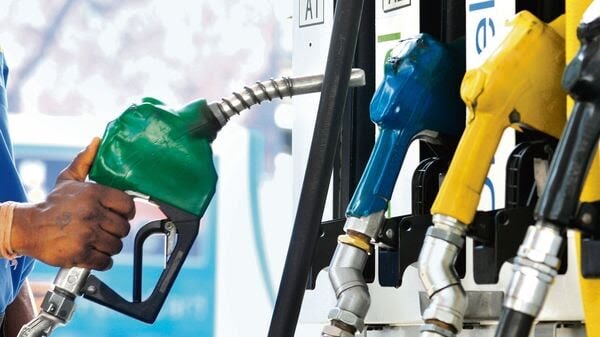
🚗🇮🇳 India’s Next Fuel Revolution: From E20 to E100?
#India ethanol policy #E20 fuel #E85 fuel #E100 fuel #Flex fuel vehicles #Ethanol blended petrol #Central Motor Vehicles Rules #CMVR #India biofuel policy #Alternative fuels in India #Green mobility India #Sustainable transport #Energy security India #Crud
India is quietly preparing for...
India is quietly preparing for a major transformation in its transport fuel ecosystem, and this move could fundamentally reshape how vehicles are manufactured, sold, and driven in the coming years.
After introducing E20 blended petrol (20% ethanol + 80% petrol), the government is now moving toward recognizing high-ethanol fuels like E85 and E100 under the Central Motor Vehicles Rules (CMVR) — a policy signal that India’s clean fuel ambitions may be much bigger than previously imagined.
This is not just a fuel policy update — it is a strategic shift touching energy security, farmers’ income, climate commitments, and the automobile industry.
---
🔍 What Is Changing?
The government is working to formally bring high ethanol-blended fuels into the regulatory framework:
✅ E20
Contains 20% ethanol and 80% petrol
Already being rolled out in phases across India
Many new vehicles are now being designed to be E20-compatible
⚡ E85
Contains 85% ethanol
Requires flex-fuel vehicles (FFVs) capable of running on varying petrol-ethanol blends
Widely used in countries like Brazil
🌱 E100
Nearly 100% ethanol-based fuel
Represents a much deeper move away from fossil fuel dependence
Could become a niche or targeted transport fuel in specific vehicle categories
📌 Key takeaway:
> India is preparing not just for blended petrol, but potentially for a high-ethanol mobility ecosystem.
---
🎯 Why Is India Pushing Ethanol?
1️⃣ Reducing Crude Oil Imports 🛢️⬇️
India imports a major share of its crude oil needs, making the economy vulnerable to:
Global oil price shocks
Geopolitical disruptions
Trade imbalance pressures
More ethanol = less imported petrol dependency
---
2️⃣ Boost to Farmers 🌾
Ethanol is largely produced from: ✔ Sugarcane
✔ Maize
✔ Agricultural biomass
✔ Other feedstocks
This can:
Create new rural income streams
Strengthen agro-industrial supply chains
Support India’s bio-economy
---
3️⃣ Cleaner Emissions 🌍♻️
Higher ethanol blending may help reduce: ✅ Carbon monoxide emissions
✅ Certain particulate pollutants
✅ Net fossil fuel use
This supports India’s:
Climate targets
Energy transition goals
Cleaner urban mobility agenda
---
🚘 How Will It Affect Car Buyers?
If India expands toward E85 / E100, consumers may see:
🔧 Flex-Fuel Vehicles (FFVs)
Cars designed to operate on:
Petrol
E20
E85
Variable blends
This gives fuel flexibility but may require:
Engine redesign
New fuel system materials
Different calibration technology
---
⛽ Fuel Availability Shift
Petrol pumps may gradually offer: ◉ Petrol
◉ E20
◉ E85
◉ Possibly E100 in select markets
India’s fueling landscape could look very different within a decade.
---
💰 Price Dynamics
Potential upside: ✅ Lower fuel cost (depending on production economics)
✅ Reduced import bill nationally
Potential challenge: ⚠ Vehicle adaptation costs
⚠ Feedstock availability concerns
⚠ Food vs fuel debate
---
⚖️ Challenges Ahead
No transition is simple. India still needs to address:
🔸 Large-scale ethanol production capacity
🔸 Water-intensive crop concerns (especially sugarcane)
🔸 Nationwide fuel distribution infrastructure
🔸 Vehicle compatibility standards
🔸 Long-term sustainability of feedstock supply
---
🧠 Current Affairs / UPSC Angle
This topic connects with:
📚 Energy Security
📚 Biofuels Policy
📚 Climate Change Mitigation
📚 Agricultural Economics
📚 Green Mobility Transition
📚 Sustainable Development Goals (SDGs)
✨ Fact to Remember
> India’s ethanol roadmap is evolving from E20 blending toward possible recognition of E85 and E100 fuels — signaling a long-term flex-fuel future.
---
📌 Bottom Line
India’s fuel transition is no longer just about adding ethanol to petrol — it is about reimagining the future of mobility.
🚜 Farmers may benefit
🚗 Automobiles may transform
🛢️ Oil dependence may reduce
🌍 Climate goals may gain momentum
The fuel in your next car may look very different from today. 🔋⚡🇮🇳
🎥 Watch explainer:
https://www.youtube.com/watch?v=N8lSG1sNBcoCurrent-Affairs • Burning Issues • Climate Change
Rare Hantavirus Outbreak on MV Hondius: Why the World is Watching
#hantavirus outbreak #Andes virus #MV Hondius #cruise ship outbreak #hantavirus #zoonotic diseases #human to human transmission #rare virus outbreak #global health alert #infectious disease #viral outbreak #Canary Islands #Spain health alert #emerging dise
A major public health alert...
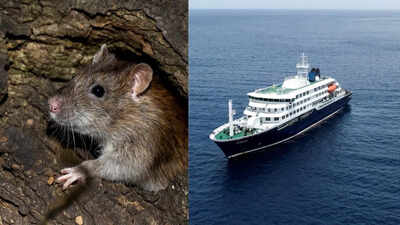
A major public health alert has emerged in the Atlantic Ocean after a rare outbreak of Andes hantavirus struck the cruise ship MV Hondius, claiming 3 lives and infecting several others as the vessel sails toward Spain’s Canary Islands for emergency response and evacuation. Health authorities across multiple countries are now tracking passengers and close contacts amid fears of limited human-to-human spread.
What makes this outbreak unusual?
Most hantaviruses spread to humans through exposure to rodent urine, droppings, or saliva, often when contaminated dust is inhaled. Human-to-human transmission is generally not seen.
However, the strain identified on board — Andes virus — is the only known hantavirus capable of spreading between humans, although this remains rare and typically requires close, prolonged contact, especially with respiratory secretions of an infected person.
Current situation onboard
Reports indicate:
3 confirmed deaths
Multiple confirmed and suspected infections
Around 150 passengers and crew under monitoring
International coordination involving Spain, WHO, European health agencies, and multiple countries for quarantine and repatriation protocols
The broader public risk is currently assessed as low, but surveillance is high due to the unusual transmission pattern.
Why this matters for current affairs
This incident is significant because it highlights:
1) Global health surveillance challenges
A cruise ship is effectively a closed ecosystem with multinational passengers, making outbreaks harder to contain.
2) Zoonotic spillover risks
Like Ebola, Nipah, and COVID-era concerns, hantavirus reminds us that pathogens crossing from animals to humans remain an ongoing threat.
3) Rare transmission pathways
Andes virus is scientifically notable because it breaks the usual hantavirus rule by showing limited person-to-person spread, making outbreak tracing much more complex.
4) International public health diplomacy
The response now involves cross-border quarantine decisions, evacuation logistics, and coordinated disease surveillance.
Symptoms to know
Severe hantavirus infection may cause:
High fever
Muscle pain
Fatigue
Headache
Dry cough
Breathing difficulty
In severe cases: Hantavirus Pulmonary Syndrome (HPS), which can become life-threatening rapidly.
UPSC / Exam angle
This topic can be linked with:
Emerging infectious diseases
Zoonotic diseases
Global health governance (WHO)
International disease surveillance
One Health Approach (human + animal + environmental health)
Key fact to remember:
> Andes virus is the only hantavirus known to spread from human to human.
Epics • Ramayana • Yuddha Kanda
जब नंदी ने ही महादेव को युद्ध की चुनौती दे दी | शिव और नंदी का अद्भुत युद्ध | Shiv vs Nandi Story 🔱
#Nandi #Mahadeva #Bali #Sugreeva #Ramayana #kiskindha
जब नंदी ने ही महादेव...
जब नंदी ने ही महादेव को युद्ध की चुनौती दे दी | शिव और नंदी का अद्भुत युद्ध | Shiv vs Nandi Story 🔱
कैलाश पर्वत पर एक बार ऐसी घटना घटी जिसने पूरे देव लोक को आश्चर्य में डाल दिया। भगवान महादेव ने अपने परम भक्त और वाहन नंदी की भक्ति और कर्तव्यनिष्ठा की परीक्षा लेने का निर्णय किया।
महादेव एक अज्ञात योद्धा का रूप धारण करके कैलाश के द्वार पर पहुँचे। उस समय नंदी को आदेश था कि बिना अनुमति कोई भी कैलाश में प्रवेश नहीं कर सकता।
जब उस अज्ञात योद्धा ने भीतर जाने का प्रयास किया, तो नंदी ने अपने स्वामी की आज्ञा की रक्षा के लिए उसे रोक दिया। इसी से आरंभ हुआ एक अद्भुत और दिव्य युद्ध।
नंदी की शक्ति और निष्ठा देखकर अंत में भगवान शिव प्रसन्न हो गए और उन्होंने स्वयं अपना वास्तविक रूप प्रकट किया। इस घटना ने यह सिद्ध कर दिया कि सच्ची भक्ति वही है जो धर्म और कर्तव्य के लिए अडिग रहे।
यह कहानी हमें भक्ति, निष्ठा और धर्म की रक्षा का संदेश देती है।
अगर आपको भगवान शिव से जुड़ी ऐसी दिव्य और रहस्यमयी कथाएँ पसंद हैं, तो वीडियो को Like, Share और Channel को Subscribe जरूर करें। 🔱
#Mahadev #ShivVsNandi #NandiDev #LordShiva #ShivaStory #ShivBhakt #HinduMythology #MahadevStory #HarHarMahadev #ShivKatha #MythologyStories #SanatanDharma #MahadevStatus #ShivaDevotee
Current-Affairs • Burning Issues • Geopolitics
Qatar–Iran Conflict: Betrayal, Self-Defense, or a Dangerous Regional Spiral?
#Iran #Qatar #Israel #Oil #Fuel #Petroleum #Gulf crisis
The latest escalation in West...
The latest escalation in West Asia has triggered intense debate across diplomatic and geopolitical circles. At the center of the controversy is Qatar?s Prime Minister **Sheikh Mohammed bin Abdulrahman Al Thani**, who has publicly accused Iran of **?betrayal?** after missile and drone strikes targeted several Gulf nations. His comments raise an important and controversial question: **Did Iran truly betray its neighbors, or is the region witnessing a predictable consequence of an escalating geopolitical conflict?**
### Qatar?s Claim of ?Betrayal?
In his first major media remarks after attacks struck Qatar, Al Thani described Iran?s actions as a **?dangerous miscalculation?** that could destabilize the entire Middle East and even trigger global economic disruptions.
According to the Qatari leadership, the anger stems from the fact that Qatar had **explicitly stated it would not participate in military operations against Iran**, even as tensions rose between Tehran and its adversaries. Despite this stance, Qatar still came under missile and drone attacks.
From Doha?s perspective, the strikes represent a violation of diplomatic trust between neighbors. Gulf states, including Qatar, have historically tried to maintain working relations with Iran despite ideological and strategic differences. For Qatar, therefore, the attack is seen not merely as a military strike but as a **political rupture in regional diplomacy**.
However, critics argue that labeling the situation as ?betrayal? oversimplifies the reality of modern geopolitics, where alliances, military logistics, and strategic territories often blur neutrality.
### Iran?s Perspective: Strategic Self-Defense?
From Tehran?s viewpoint, the attacks appear to be framed as **retaliation and strategic deterrence** rather than betrayal. Iran has warned that any neighboring country whose territory is used to launch attacks against the Islamic Republic may become a target.
Iranian leadership has consistently maintained that if foreign powers conduct strikes against Iran using bases or logistical support from nearby countries, those countries effectively become part of the conflict. This position reflects Iran?s long-standing security doctrine.
The statement from Iranian President **Masoud Pezeshkian** reinforced this warning. He indicated that Iran would be ?forced to respond? against regional states if their territory was used for military operations against Tehran.
This perspective introduces a difficult geopolitical dilemma: **Can Gulf nations truly remain neutral in a conflict involving major global powers operating in their region?**
### Civilian Targets and Ethical Concerns
One of Qatar?s strongest accusations is that **a significant portion of the attacks targeted civilian infrastructure**, with estimates suggesting roughly **25 percent of strikes hit non-military facilities**.
If accurate, this raises serious ethical and legal questions under international law. Civilian infrastructure is generally protected under the laws of armed conflict, and deliberate targeting could constitute a violation of humanitarian norms.
Iran has not fully accepted these accusations, instead maintaining that its strikes were aimed at strategic assets connected to military activity. As with many modern conflicts, **the truth likely lies somewhere between official narratives and battlefield realities**.
### A New Leadership in Iran
The geopolitical tension has intensified further following a major leadership shift in Iran. After the death of **Ali Khamenei** during US-Israeli strikes, Iran?s Assembly of Experts appointed **Mojtaba Khamenei** as the country?s new supreme leader.
Mojtaba Khamenei is widely perceived as a **hardline figure closely aligned with the Revolutionary Guards**, a development that could significantly shape Iran?s strategic posture. Hardline leadership often signals a more confrontational foreign policy, especially during times of national crisis.
Supporters of Iran?s decision argue that such leadership may strengthen internal unity during war. Critics fear it could **harden regional divisions and prolong conflict**.
### The Gulf Under Fire
The widening conflict has not been limited to Qatar alone. Reports indicate missile and drone activity across multiple Gulf states, including Saudi Arabia, Kuwait, and Bahrain.
Saudi air defenses reportedly intercepted drones targeting oil infrastructure, while Kuwait?s defense systems were activated against incoming missiles and drones. Bahrain also reported injuries following a drone strike.
These developments highlight how quickly a localized confrontation can **spread into a multi-state regional crisis**.
### Economic Shockwaves Beyond the Region
Perhaps the most concerning consequence of the escalating conflict is its global economic impact.
The Gulf region remains one of the world?s most critical energy hubs. Any disruption to oil infrastructure or shipping routes immediately affects global markets. As tensions intensified, crude oil prices surged past **$100 per barrel**, triggering concerns reminiscent of the global market shocks following the **Russian invasion of Ukraine**.
Asian markets reacted quickly, with stock exchanges in Japan and South Korea opening lower amid fears of prolonged instability in West Asia.
For energy-importing nations, including many in Asia and Europe, the conflict could translate into **higher fuel prices, inflation, and economic uncertainty**.
### Diplomacy or Escalation?
Despite his harsh criticism of Iran, Qatar?s Prime Minister emphasized the importance of de-escalation. His message reflects a difficult reality: **geography cannot be changed**. Iran and the Gulf states will remain neighbors regardless of political tensions.
This geographic reality makes diplomacy not just desirable but necessary.
Yet achieving meaningful negotiations will be extremely difficult. Multiple actors—including Iran, Israel, Gulf states, and global powers such as the United States—are now entangled in the conflict. Each side has strategic interests that make compromise complicated.
### The Real Question: Who Benefits from Escalation?
Ultimately, the debate surrounding Iran?s actions and Qatar?s accusations reveals a deeper issue: **Who actually benefits from the expansion of this conflict?**
Regional wars rarely produce clear winners. Instead, they tend to weaken economies, destabilize governments, and deepen ideological divides. Civilian populations bear the greatest cost.
Some analysts argue that escalating tensions strengthen hardliners across all sides, making diplomacy politically difficult. Others believe strong retaliation is necessary to deter future attacks.
The truth may be that **both arguments contain elements of reality**.
### Conclusion
Qatar?s accusation of betrayal against Iran has ignited a broader debate about neutrality, regional alliances, and the limits of diplomacy during wartime. While Doha views the strikes as an unjustified attack on a neutral neighbor, Tehran frames its actions as strategic retaliation and defense.
What is clear is that the situation has moved beyond a simple bilateral dispute. With leadership changes in Iran, military actions across multiple Gulf states, and rising global energy prices, the conflict now carries **regional and global consequences**.
The pressing question is not only **who is right**, but **whether the region can avoid a full-scale spiral into prolonged war**.
If diplomacy fails, the costs will likely extend far beyond West Asia—affecting economies, politics, and security across the world.
Academic • History • General
Bali | Story of *Vanara* — A Different Lens on Bali
#bali #kiskindha #ramayana #sugreeva #ram #ravana
## Story of *Vanara* —...
## Story of *Vanara* — A Different Lens on Bali
?Anand has been one of those people who has adopted neutral storytelling, leaving the perception to the readers… it is interesting to witness how he has put Hanuman and Bali in this book.? — S. S. Rajamouli, filmmaker. This observation beautifully captures the spirit of *Vanara*, a 2018 novel by Anand Neelakantan, a debut Indian writer known for presenting epic characters from unconventional perspectives. His literary works include *Asura: Tale of the Vanquished*, *Ajaya: Roll of the Dice*, *Ajaya: Rise of Kali*, the *Bahubali Trilogy*, *Bhoomija: Sita*, *Shanta*, and *Vanara*. Among these, *Vanara* stands out as a deeply human narrative that re-examines the life of Bali — not merely as a character from the Ramayana, but as a layered, emotional, and heroic figure shaped by destiny, love, and misunderstanding.
At its heart, *Vanara* revolves around a compelling triangle of emotions — the intertwined lives of Bali, Sugreeva, and Tara. The novel traces the journey of Bali and Sugreeva from childhood to adulthood, portraying their growth, rivalry, affection, and eventual estrangement. Both brothers belong to the Vana Nara tribe, and unlike the conventional depiction that reduces them to primitive beings, the novel presents them as thinking, feeling individuals navigating complex circumstances. Bali emerges as the hero of the story — strong, protective, and often misunderstood — while Sugreeva is shown with a different shade of innocence and vulnerability. The narrative does not rush to judge; instead, it quietly unfolds events, allowing readers to decide where sympathy lies.
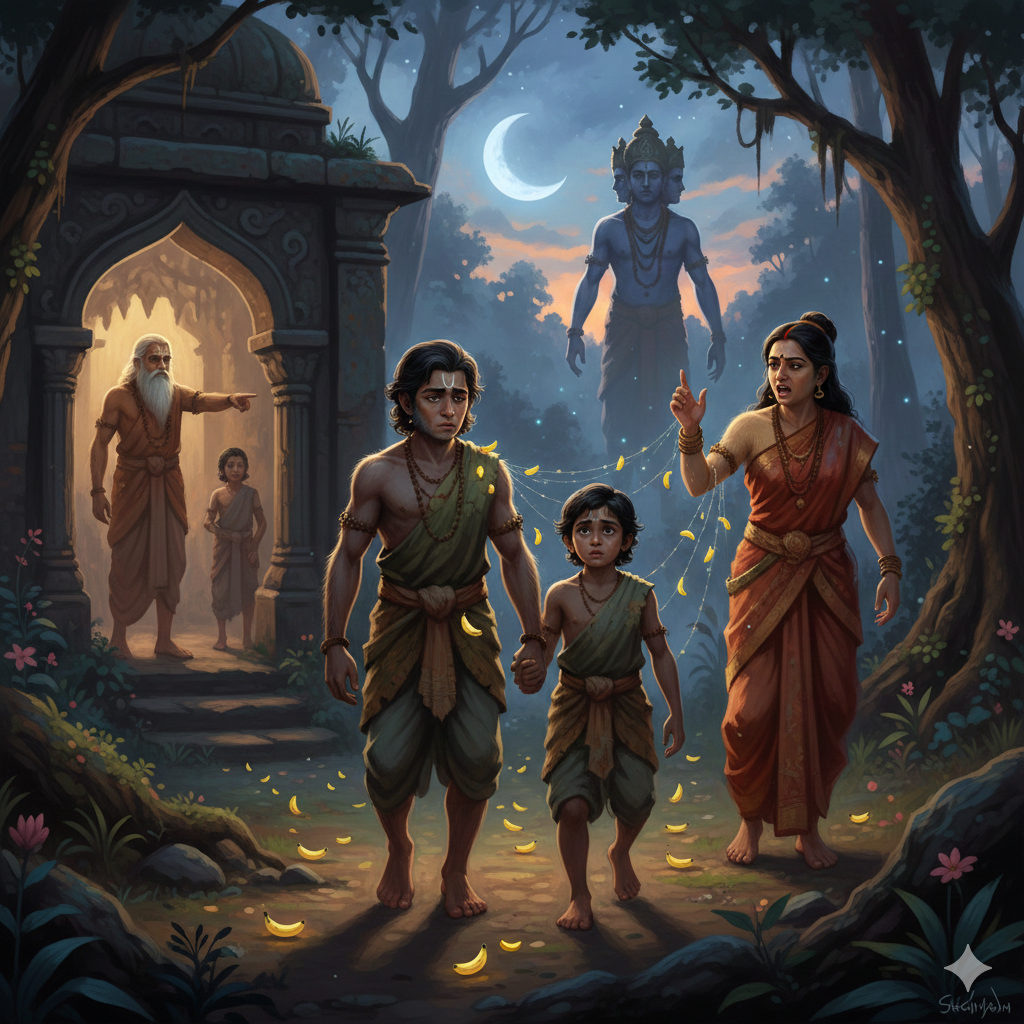
The story begins in their childhood, under the care of the sage Gautama and his wife Ahalya in the peaceful environment of an ashram. During these early years, Sugreeva is the favored one, receiving affection and attention. Bali, though equally present, does not enjoy the same warmth. This subtle difference in treatment quietly plants the seeds of emotional contrast between the two brothers. Then comes a turning point — an incident that changes their lives forever. Sugreeva happens to witness an illicit relationship between Ahalya and Indra. Troubled and confused, he confides in Bali. Here, Bali?s protective instinct surfaces; he warns his younger brother not to reveal what he has seen. But Sugreeva, driven by innocence and perhaps a rigid sense of right and wrong, informs Gautama about the incident.
What follows is dramatic and tragic. Gautama, enraged by the betrayal, punishes Ahalya and castrates Indra. Shame and fury consume Ahalya, and in her anger, she directs a curse at Bali — believing that he was the one responsible for exposing her secret. She curses him that he will one day be killed by his own brother. Imagine the weight of such a curse, especially when placed upon someone who was not even at fault. This moment marks the first major injustice in Bali?s life. He becomes the scapegoat, blamed for an action he did not commit. As a consequence of the turmoil, both Bali and Sugreeva are expelled from the ashram. Their childhood ends abruptly, replaced by uncertainty and exile.
This initial episode is crucial because it shapes the emotional foundation of the novel. It presents Bali as a character burdened by misunderstanding from a young age, while Sugreeva?s innocence, though genuine, becomes the catalyst for unintended destruction. The contrast is subtle yet powerful: Bali exercises caution and loyalty, while Sugreeva?s straightforward honesty triggers consequences neither of them foresaw. Through this beginning, *Vanara* invites readers to reflect on themes of blame, perception, and destiny. Is Bali truly the villain history remembers, or was he a victim of circumstances beyond his control? The novel does not dictate an answer — it simply narrates, leaving the judgment to us.
In retelling Bali?s early life in this manner, Anand Neelakantan challenges the singular narrative of the epic tradition and encourages readers to explore empathy beyond established labels. The story of *Vanara* thus begins not with grandeur, but with childhood, mistake, curse, and exile — the fragile threads that eventually weave the destiny of a hero who history may have misunderstood.
Competitions • Quizzes • General
Panchayati Raj’s innovative **SabhaSaar**
#sabhasaar #panchayati raj #polity
Since its landmark launch on...
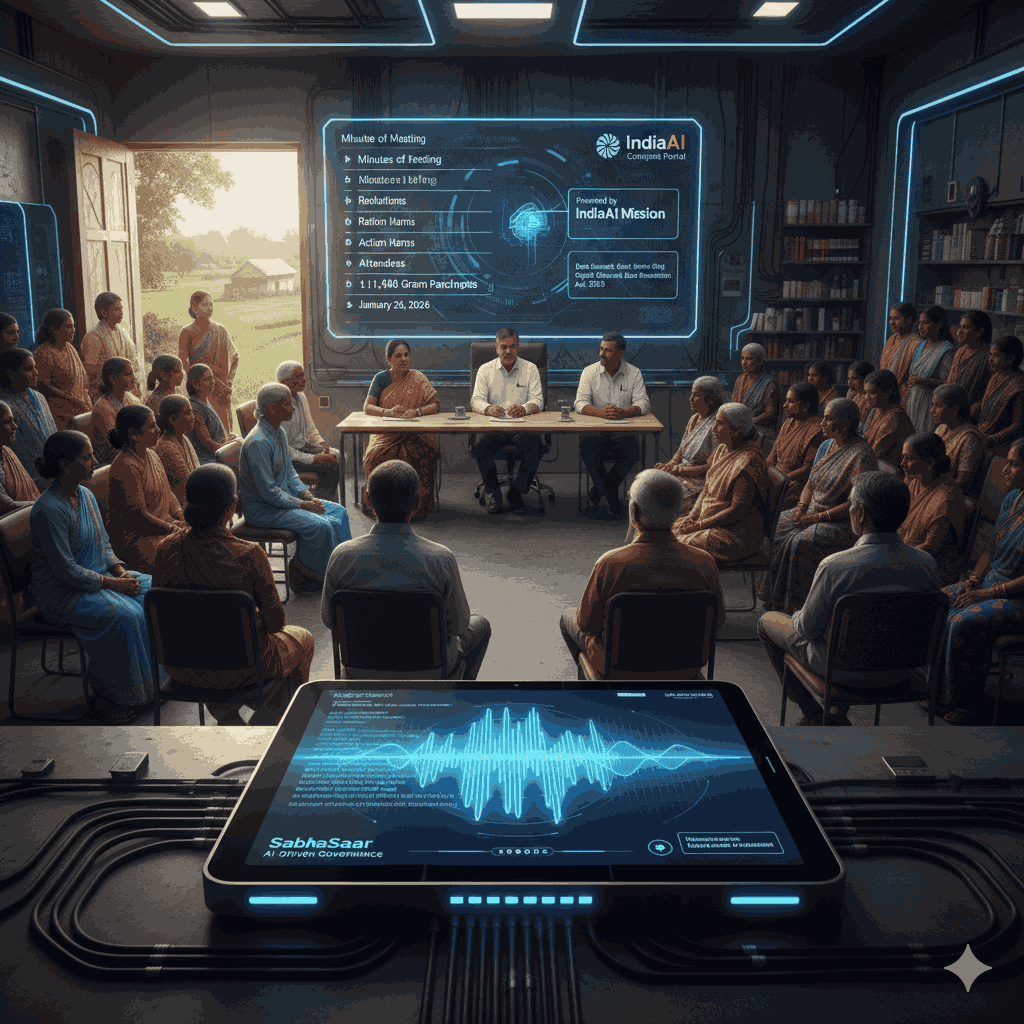
Since its landmark launch on August 14, 2025, the Ministry of Panchayati Raj?s innovative **SabhaSaar** platform has fundamentally redefined local governance, with **1,11,486 Gram Panchayats** already adopting this AI-driven tool as of late January 2026. By leveraging the robust cloud infrastructure of the **IndiaAI Compute Portal** under the **IndiaAI Mission**, SabhaSaar seamlessly converts live speech from Gram Sabha meetings into structured, digital Minutes of Meeting. This sophisticated voice-to-text engine meticulously records meeting types, dates, and attendee deliberations, while automatically documenting resolutions and actionable follow-up points for validation by local functionaries. Recognizing the sensitivity of grassroots data, the system ensures all processing remains strictly within government servers—void of third-party sharing—and operates under the stringent governance of the **Digital Personal Data Protection Act, 2023**. This digital transformation not only streamlines administrative workflows but also reinforces a secure, transparent, and high-tech future for India's rural self-governance.
Academic • General
The Union Budget 2026–27
#Union Budget #Fiscal Consolidation #Nirmala Sitaraman #Budget
The Union Budget 2026–27 serves...
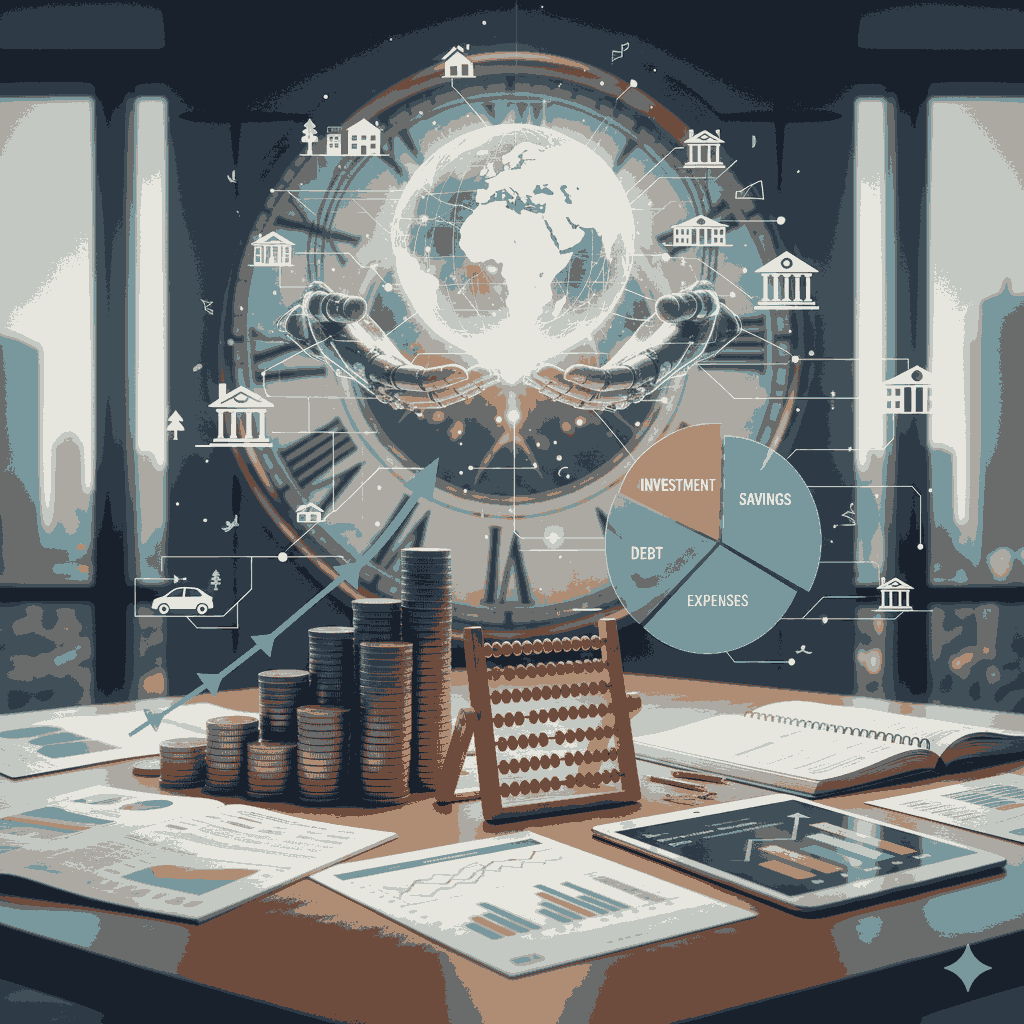
The Union Budget 2026–27 serves as a strategic roadmap for India's transition toward a technology-led economy, prioritizing advanced sectors such as artificial intelligence, semiconductors, and biopharma as part of the Viksit Bharat 2047 vision. A critical shift in fiscal policy is evident as the government restructures expenditure to favor long-term asset creation over daily operations, reducing revenue expenditure from 88 percent in 2014–15 to a projected 77 percent. While public capital investment remains a primary driver for infrastructure, the budget faces challenges including a cooling momentum in capital expenditure growth and an execution gap between budgeted targets and actual spending. Furthermore, maintaining macroeconomic stability is complicated by low tax buoyancy, particularly in indirect taxes, and a evolving federal fiscal framework where states may face reduced central transfers. Complementing these domestic efforts is the landmark India-U.S. Trade Deal, which significantly slashes tariffs on Indian goods and enhances the competitive edge of labor-intensive sectors like textiles and electronics. Together, these internal fiscal consolidation efforts and external diplomatic achievements represent a dual approach to securing national growth and building resilient, trusted global supply chains.
Academic • General
Chhatrapati Shivaji Maharaj
#Chhatrapati Shivaji Maharaj #Vir Shivaji #Marathas #Aurangzeb #Indian history #Modern Indian History #Marathawada #Marathi
Chhatrapati Shivaji Maharaj (1630–1680) was...
Chhatrapati Shivaji Maharaj (1630–1680) was the founder of the Maratha Empire and one of the greatest warrior-kings in Indian history, known for his military genius, administrative innovation, and vision of self-rule (*Swarajya*). Rising against the dominance of the Mughal and Adil Shahi powers, he established a strong and independent kingdom in the Deccan through guerrilla warfare, strategic fortifications, and a disciplined army and navy. Shivaji introduced an efficient administrative system with councils like the *Ashta Pradhan*, promoted local governance, fair taxation, and protection of peasants, and emphasized religious tolerance and justice. He was crowned Chhatrapati in 1674 at Raigad, symbolizing the assertion of indigenous sovereignty. Shivaji Maharaj?s legacy lies not only in his military achievements but also in his ideals of governance, nationalism, and people-centric rule, which inspired later Indian resistance movements.
Academic • General
About Studento
#studento #upsc #civil services #history #polity #geography
**Studento.co.in** is an Indian educational...
**Studento.co.in** is an Indian educational website designed mainly for **UPSC and civil services aspirants**, providing study materials, exam guidance, and learning tools in a digital format. Its mission is to help students prepare efficiently for competitive examinations by offering curated resources, mock tests, mentorship insights, and a supportive learning community.
The platform features sections on history, polity, economics, environment, and other subjects, along with answer-writing practice, quizzes, study analytics, and focused learning plans. It also offers blogs, dashboards, and interactive tools to improve productivity and exam preparation.
In short, **Studento.co.in is an online learning and exam-preparation portal focused on civil services and academic aspirants, combining content, tools, and community support for competitive exams.**
Academic • General
Digambars
#digambars #jain #culture #religion
The Digambars are one of...
The Digambars are one of the two major sects of Jainism, the other being the Shvetambaras, and their name literally means ?sky-clad,? symbolizing complete renunciation of worldly possessions, including clothing. Digambar Jains believe that true liberation requires absolute detachment from material objects, and therefore their monks practice nudity as an expression of spiritual purity and non-attachment. They hold that women cannot attain moksha (liberation) in their present form and must be reborn as men, a belief that distinguishes them from the Shvetambaras. Digambars recognize a different canon of Jain scriptures, emphasizing texts like the *Shatkhandagama* and *Kasayaprabhrta*, and they revere the 24 Tirthankaras, especially Lord Mahavira, as spiritual exemplars. Their temples, rituals, and iconography typically depict the Tirthankaras in nude form, reflecting their core philosophical ideal of renunciation and asceticism.
Academic • General
The Ancient Astronomer | Varahamihira
#varahamihira #astronomy #astronomer #ancient #history
Varahamihira (c. 505–587 CE) was...
Varahamihira (c. 505–587 CE) was a celebrated Indian astronomer, mathematician, and scholar associated with the Gupta period, often regarded as one of the greatest scientific minds of ancient India. He was a prominent member of the legendary *Navaratnas* (nine gems) in the court of Emperor Vikramaditya (Chandragupta II) and made significant contributions to astronomy, astrology, mathematics, meteorology, and geography. His major works include *Brihat Samhita*, an encyclopedic text covering subjects like astronomy, weather prediction, architecture, agriculture, and omens, and *Pancha Siddhantika*, which summarized five earlier astronomical systems and helped preserve ancient scientific knowledge. Varahamihira accurately described planetary motions, eclipses, and the concept of the Earth?s rotation, and he also recognized the influence of the Moon on tides. His interdisciplinary scholarship reflects the high level of scientific and intellectual development in classical India.
Academic • General
Short note on Vishnugupta aka Chanakya
#history #ancient #indian history
Chanakya, also known as Kautilya...
Chanakya, also known as Kautilya or Vishnugupta (c. 4th century BCE), was a renowned Indian philosopher, economist, jurist, and political strategist who played a decisive role in the rise of the Maurya Empire. He was the chief advisor and mentor of Chandragupta Maurya and is credited with masterminding the overthrow of the Nanda dynasty and the establishment of Mauryan rule. Chanakya is best known as the author of the *Arthashastra*, a comprehensive treatise on statecraft, administration, economics, diplomacy, espionage, and military strategy, which reflects his pragmatic and realist approach to governance. His political philosophy emphasized strong centralized authority, efficient administration, and the welfare of the state as the highest priority. Chanakya?s ideas influenced Indian political thought for centuries and earned him the reputation of India?s earliest and greatest political theorist.
Academic • General
The Chandragupta Maurya
#maurya #chandrgupta maurya #history
Chandragupta Maurya (c. 321–297 BCE)...
Chandragupta Maurya (c. 321–297 BCE) was the founder of the Maurya Empire and one of the greatest empire-builders in ancient Indian history. Under the guidance of his mentor and strategist Chanakya (Kautilya), he overthrew the Nanda dynasty and established a centralized empire with its capital at Pataliputra (modern Patna). Chandragupta expanded his territory across most of the Indian subcontinent through military conquests and diplomatic alliances, including a treaty with Seleucus I Nicator, one of Alexander?s successors, which secured northwestern India for the Mauryas. His administration was highly organized, with a strong bureaucracy, efficient taxation system, and a powerful standing army, as described in the Arthashastra and by Greek accounts such as Megasthenes? *Indica*. Chandragupta Maurya later abdicated the throne in favor of his son Bindusara and embraced Jainism, spending his final years as an ascetic, thus leaving a legacy of political unity and administrative excellence in ancient India.
Academic • General
Era of Pulkeshin II
#pulkeshin #history #ancient indian history
Pulakeshin II (r. 610–642 CE)...
Pulakeshin II (r. 610–642 CE) was the most illustrious ruler of the Chalukya dynasty of Badami and is celebrated as one of the greatest rulers of early medieval India. He consolidated Chalukya power in the Deccan, defeated the Kadambas, Gangas, and Mauryas of the Konkan, and established Chalukya supremacy over much of South and Central India. His most notable achievement was halting the northward expansion of Harshavardhan at the banks of the Narmada River, thereby establishing the Vindhyas as the boundary between the northern and southern spheres of power. Pulakeshin II was also a patron of art and architecture, contributing to the development of the rock-cut cave temples at Badami and the early Chalukyan architectural style. His reign marked the height of Chalukya political power and cultural influence, though the kingdom later suffered setbacks due to conflicts with the Pallavas.
Academic • General
Reign of Harshavardhana
#harshavardhan #history #
Harshavardhan (r. 606–647 CE) was...
Harshavardhan (r. 606–647 CE) was one of the most prominent rulers of the Pushyabhuti dynasty and established a powerful empire in northern India with Kannauj as his capital, following the decline of the Gupta Empire. He expanded his control over large parts of North India through military campaigns, though he was checked in the south by the Chalukya ruler Pulakeshin II. Harshavardhan is remembered not only as a conqueror but also as a patron of learning, culture, and religion; he supported both Buddhism and Hinduism, built monasteries and temples, and organized grand religious assemblies. His court was renowned for scholars such as Banabhatta, the author of *Harshacharita*, and he maintained diplomatic relations with China, as recorded by the Chinese pilgrim Xuanzang. Harshavardhan?s reign marked a brief revival of political unity and cultural prosperity in early medieval India.